 Episode 32
· 13:49
Now, if you're selling your home, one of the most exciting and sometimes stressful times is when that first strong offer comes in, and the big question comes, do you take it or do you wait for something better? Because no one wants to undersell, but at the same time, waiting can come with risks.
Particularly in a declining market like we're probably just going into right now.
Okay.
Prices could be lower in three months' time if you decide not to sell, so just take that into account, that markets don't always go up.
So I guess the main takeaways, um, on receiving a strong offer early on is we're assessing the full offer, not just the price point.
Um, make a strategic decision, not just one based on emotion and feelings
Welcome to the Selling Southport Podcast. I'm Andrew Wright, principal of Professional Southport since 2008. Real estate isn't just my career, it's my passion. With decades of experience, I know what it takes to succeed in the property market, especially here in Southport. Whether you're looking to buy, sell, lease, or invest, you can count on me and my team to deliver strategies that maximise your returns.
Let's dive into today's episode and get you one step closer to your property goals
Hi, everyone, and welcome back to Selling Southport. Now, if you're selling your home, one of the most exciting and sometimes stressful times is when that first strong offer comes in, and the big question comes: Do you take it or do you wait for something better? Because no one wants to undersell, but at the same time, waiting can come with risks.
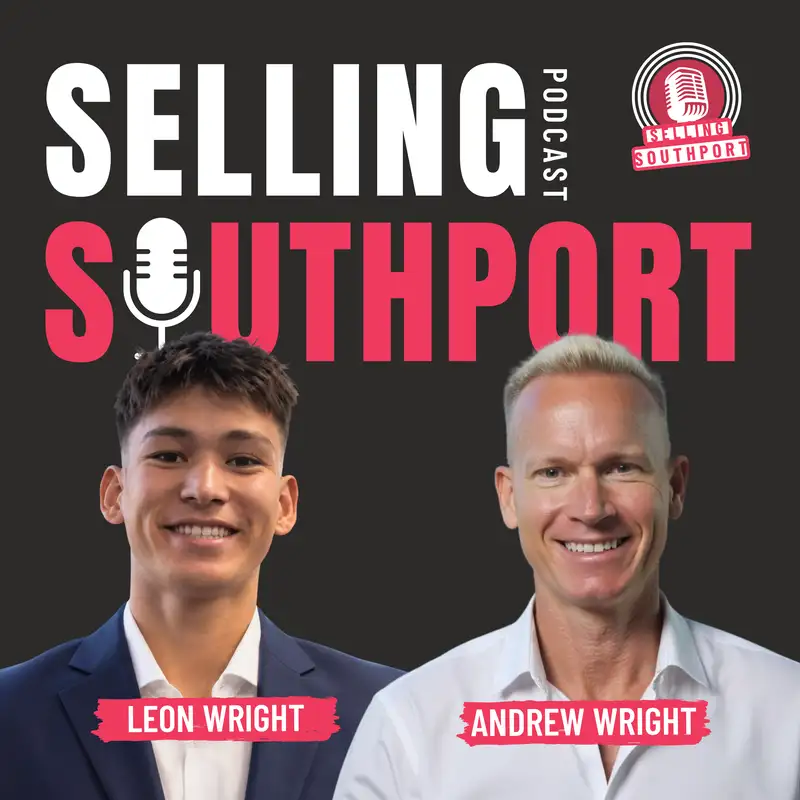
So today we're gonna break down how sellers can think about this decision properly. I'm joined again by Andrew Wright today. Uh, Andrew is my father and the principal of Professional Southport. Andrew, in this kind of situation, how should sellers approach that first strong offer?
Yeah, look, it's interesting, uh, Leon.
Before I bought this business in 2008, I became a real estate agent in 1992, straight out of university, and the first thing that the training course told me there was quite often the first offer you get is the best, and it's, it's always held true for the last, uh, 30 or 40 years since then. Uh, quite often the first offer is the best.
So it's really about having trust and a rapport with the agent and going through comparable sales and actually having the ability to know if you're pretty close to top dollar. Now, sometimes it might be that the first offer is a fraction below your expectations. But if the terms of the offer are very solid, if it's very, very close to top dollar And it's a cash offer or you're confident that they have preapproval and the deal can be done Yeah
it may just provide the seller with an opportunity to move on to the next property or the next transaction stress-free and knowing that you sold, for example, within $10,000 of what we thought top dollar would be- Yeah ... is quite often the way to go. Now, you should have the ability in the early stages, though, to go to your agent and say, "Look, we've only been marketing the property for a week.
How do you know if this is top dollar?" And if you've got an experienced agent, they should look you in the eye and say, "Look, well, we don't actually know it's absolute top dollar. Why don't we go back to the buyer and say, 'Look, the seller knows that you've put in a good offer here, but we're a little bit concerned we might get offered 20 grand more next week if we do another o- open home.
Are you open to just offering a little bit more to take this property off the market so we can try and get you the best deal possible?'" Now, if the buyer says, "No, that's my top dollar," well, then you've got a decision to make, but a good agent will always try and get you the top dollar, and it's important that you trust your
agent to do that.
So it's, it's definitely important to trust the agent, but even if you do trust the agent, um, it's still a very stressful thing. Um, why do you think sellers find it so challenging to make these decisions?
Well, they don't sell property too often in their lifetimes. It, selling a house and buying a house is a, is a high-stress time in your life.
It, I think it comes, uh, not far down the list after having children Yeah ... or, or getting divorced or getting married. So it's right up there in the, on the things to be stressed about. So,
okay. Well, before deciding, um, how do you determine whether your offer is actually strong or wh- whether an offer is actually strong?
Are we just looking at the price relative to the market, the terms, the conditions?
Yeah, well ob- when a, uh, an agent is appointed, obviously he's presented an appraisal, he's presented you with what their opinion of fair market value is with, with perhaps three to five comparable sales. And it's very important as a seller that you go through those sales and make sure that you're confident in what the agent is telling you is fair market value.
Now, as far as the offer goes, it's very, very important that if it's subject to finance, that the agent has confirmed that the buyer's actually pre-approved for finance. There's nothing wrong with an agent asking the buyer to provide a copy of the letter showing that they've been pre-approved for finance.
And it's also very, very important that the agent tries to get the maximum deposit allowable under the law when they go to contract. So in Queensland, we're allowed to have a full 10% deposit, and if for some reason that buyer changes their mind and doesn't settle, the owner keeps the full 10% deposit. If someone's only got a $1,000 deposit down, even if they go unconditional, if they don't settle, $1,000 isn't even gonna cover the legal fees of the seller.
So it's important not just the price, but that the agent gets the best terms possible To put the owner in a position
of strength. Okay. So it's really important for the agent to, I guess, do their job in getting the b- best offer possible out of the buyers. But what if we want some other offers as well?
Like, how much does the buyer competition influence whether a seller should accept or hold off on taking an offer?
Well, as well as the initial appraisal where an agent comes and tells someone what their property is worth, they also have to earn the right to sit there with confidence and tell you, "Look, seller, I think you should take this offer or negotiate with this person."
The only way an, an agent can earn the right to provide you with that advice is to do the inspections. So make sure you get people in the first 14 days to the open homes while the, the, the property is fresh on the internet, the buyer inquiry is high, the phone calls are high. You need to get as many people through that property in the first couple of weeks as possible so the agent can actually get the feedback from the buyers on the good things and the bad things about your property, so you can have an analysis there to give you confidence on whether you're accepting the highest and best offer, or very, very,
very close to.
Okay. So we've got to trust our agent and especially when it's really competitive, that's when we've got to understand we're most likely to receive our best offers. Okay, but what, what if we wanna hold out for something better? What are the risks associated if we decide l- let's put them aside for a second and see if we can get something better?
Well, let's go through
that example of that townhouse we showed, uh, two weeks ago, Leon- Yeah ... uh, in Queen Street. We had about, uh, somewhere between 16 and 18 buyers through that property first weekend, which is a good open home. Yeah. Okay? We had three written offers the first open home, well, the next day after the first open home, 720, 725 and 730, all pretty close to each other.
We were marketing that property without a price. Yeah. And w- the owner decided that they wanted to go for another week because he wasn't quite sure whether what top dollar was, and neither did we. Sometimes the agents don't have comparable sales. This one was a two-bedroom townhouse. There weren't any recent comparable sales, so we weren't sure either.
So we Wrightd for an extra week. Yeah. We didn't counter those three initial offers, and the next week, because there were tenants in place, we could only do one open home on a Saturday. We couldn't do the Sunday, and it started pouring down in rain. There was no parking in the area and only had one buyer turn up.
Now, the next day, we went back to those initial three buyers who had submitted offers. The highest bidder had already started negotiating on another property 'cause it was a week later. The bottom bidder was not prepared to increase 'cause they were at their borrowing maximum, and we're still waiting on the one in the middle This week, a few days later, to see if they'll increase their offer or whether they're going to buy another property.
So we've lost all that momentum, and maybe in that situation there, had we have had a comparable sale, it would've been a lot easier for us to tell the owner, "Well, look, let's go and counter it this..." But we're very, very close to top dollar there, and I'm sure we'll sell that property shortly. Hopefully.
Luckily, that owner's getting rent in the meantime, but if you've got an empty house and you're missing out on $1,000 a week rent every week, and the rates and body corporate invoices are coming in, there's a big opportunity cost there of not making a quick decision and moving on to the next
deal. Okay. So sounds like the main thing is we lose our best buyers, uh, we lose that sense of competition, and, um, all of a sudden by putting it off, we've sort of waved a hand to all the best buyers, and all of a sudden there's no one left.
Well, quite often, uh, even in a period of two weeks, it, when you first put a listing on the internet, buyers might search. You have an option there. It can be by feature property or it can be newest to oldest, and a lot of the buyers that are looking will probably go newest to oldest. And, uh, after two weeks, it's very common for you to be on page seven or eight, not page one or two- Understand
and you're just gonna, not gonna get the new inquiry.
Okay.
So when does it actually make sense to accept an offer we've got really early on? We think it's a fairly strong offer, but when does it make sense to just go with
it? Get advice from your agent. The agent will know based on the open home inspections whether there are other buyers sitting in the wings that might be in a position to make a strong offer.
The, the, buyers will usually say, "Look, I'm, I'm thinking of making an offer. I've just gotta go and chat to my bank manager tomorrow," or something along those lines. Talk to your agent and get advice, but if it's very, very close to what the agent predicted was top dollar and the terms are very, very good, if it's a cash offer in particular, um, it's going to be a lot, uh, more compelling to accept a cash offer than one that's subject to perhaps 30-day finance clause or subject to the sale of another property or some terms that could, you know, really,
uh, extend the settlement date.
So the main thing is trusting our agents, um, listening to the things that might be the right reason to take this offer, um, what might be a reason to hold off on making another, and quite literally just understand the situation and, uh, take the agent's advice or make a decision, um, based on our circumstances.
Y- a-
absolutely. Look, only the agent will know how many new inquiries are sitting there f- the last few days on, on his email. What happens when someone inquires on realestate.com? It sends an email to the agent, "Oh, look, I'd like to inspect this property," or, um, "Can you give me more information about the body corporate on this property," et cetera.
So the agent will know if there's plenty more inquiry there, and, uh, the offer is not quite what we think might be top dollar, the agent's gonna tell you, "Look, let's go and do another weekend of open homes and see if we can extract a better offer from the market." But if the agent sees that there's no more inquiry there, and we feel that the, um, the offer is pretty close to top dollar, the agent's probably gonna recommend that you either accept the offer or negotiate with that buyer to try and get a deal done so you can move on.
And particularly in a declining market, like we're probably just going into right now-
Okay ...
prices could be lower in three months' time if you decide not to sell. So just take that into account, that markets don't always go up.
Oh, that's really interesting. So I guess the main takeaways, um, on receiving a strong offer early on is we're assessing the full offer, not just the price point, um.
We're really looking at the conditions and how it affects our circumstance, uh, the risk versus reward of accepting an offer or holding off, which we have to trust our agent to give us the right advice and, um, make a strategic decision, not just one based on emotion and feelings.
Yeah, and the agent will let you know.
You should ask your agent, "Are there any other buyers looking to make an offer in the next couple of days?" The agent will be transparent with you and tell you what, what the level of inquiry is for that property at the moment. All right.
Well, it's very interesting. Thank you for that, Andrew. Um, thank you for listening to today's episode of Selling Southport.
Uh, if you have any questions, uh, for Andrew or myself about making an offer, uh, accepting an offer, or selling your home, uh, please feel free to reach out to either of us. Uh, we're always on the mobile, or you can send us an email. And, um, yeah, and thank you, and thank you, Andrew. Thanks, Leon.
Thanks for listening to the Selling Southport podcast.
I hope today's episode has given you some valuable insights and practical advice on the local real estate market. Whether you're looking to buy, sell, lease, or invest, I'm here to share my extensive experience and guide you every step of the way. If you have any questions or want to discuss your next property move, don't hesitate to reach out.
Your success is my priority. Stay tuned for more expert tips and updates on the Southport property scene.
Listen to Selling Southport using one of many popular podcasting apps or directories.